
AtıkZONE The path of waste. The whole of the operation.
AtıkZONE brings collection, licensed facility and recycling processes together with environmental reporting in a single management structure.
Who uses it
Used by municipalities, waste operators and field operations teams.
What problem it solves
In waste management every stage depends on the next. When collection, facility and recycling are managed separately, the whole picture is not visible. AtıkZONE tracks these stages in the same structure.
The three sides of the waste chain
Waste management brings three sides together: the citizen or business producing the waste, the team collecting it and the licensed facility processing it. AtıkZONE brings all three onto the same platform. It was developed with field experience gained in zero-waste and maritime waste projects, and it is adapted for municipalities, organised industrial zones and large facilities.
The citizen or business producing waste
The first link in the waste chain. Citizens drop their waste off at the nearest point and see in the app the points they have earned and the carbon equivalent recycled.
The collection team
Carries out in the field the collection planned around vehicles, routes and container fill levels.
The licensed facility processing it
Accepts the waste shipped to it; the batch stays on record with its type, weight and carbon equivalent.
Municipality, industrial zone and large facility
Follows the whole process from the organisation dashboard and gets environmental reports in the format the regulations require.
What AtıkZONE tracks
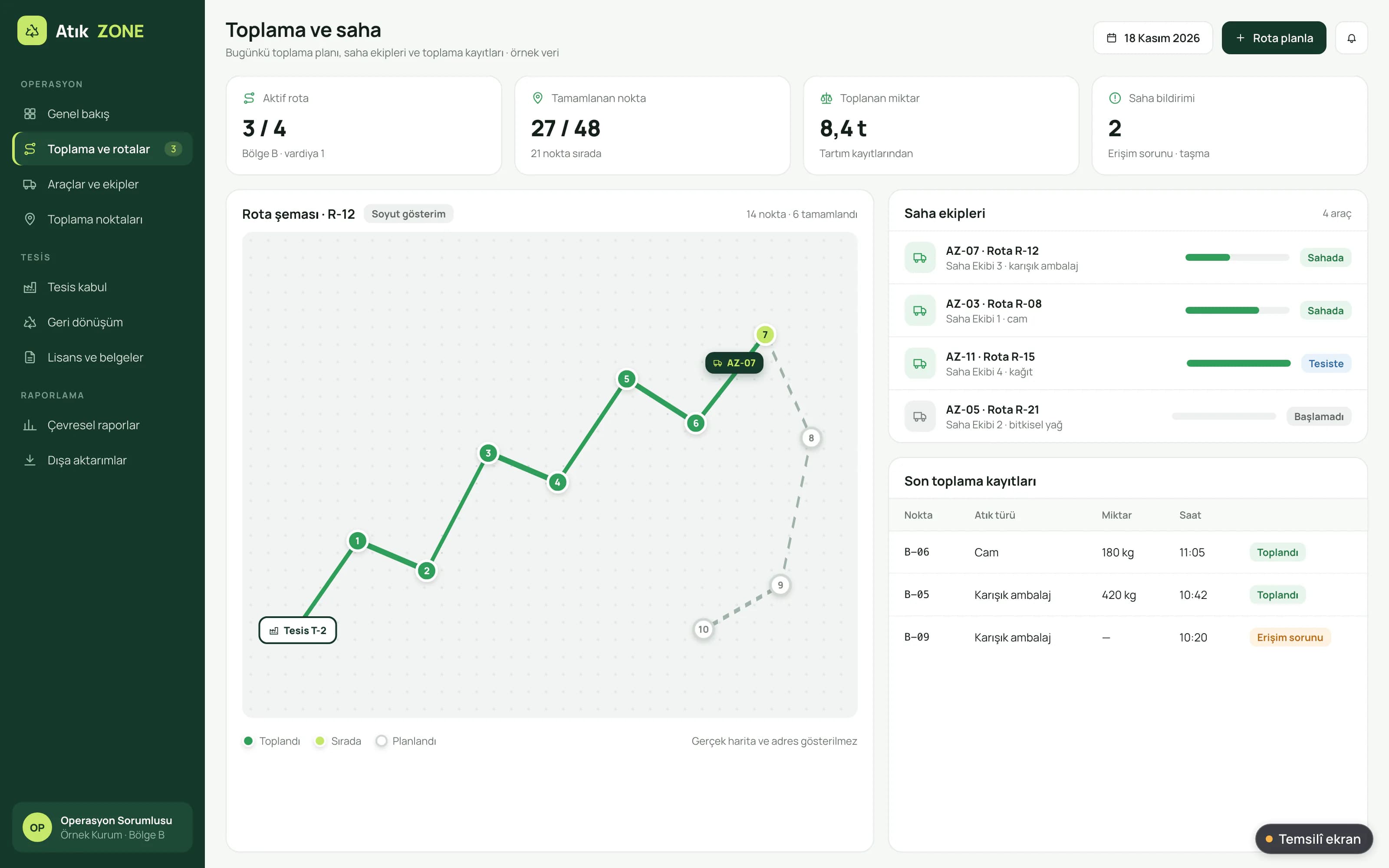
Collection and field
Waste collection processes are planned. Field operations are managed from the same system.
- Collection vehicles and routes are tracked on the same dashboard.
- Container fill levels appear on the same dashboard too.
- Waste collection, transport and field operations are managed together.
Facility and recycling
Licensed facility management and recycling processes are handled together. The stages after waste is accepted at the facility are tracked.
- Shipments to licensed facilities are visible on the organisation dashboard.
- Integration with licensed facility software can be set up.
- Every waste batch is recorded with its type, weight and carbon equivalent.
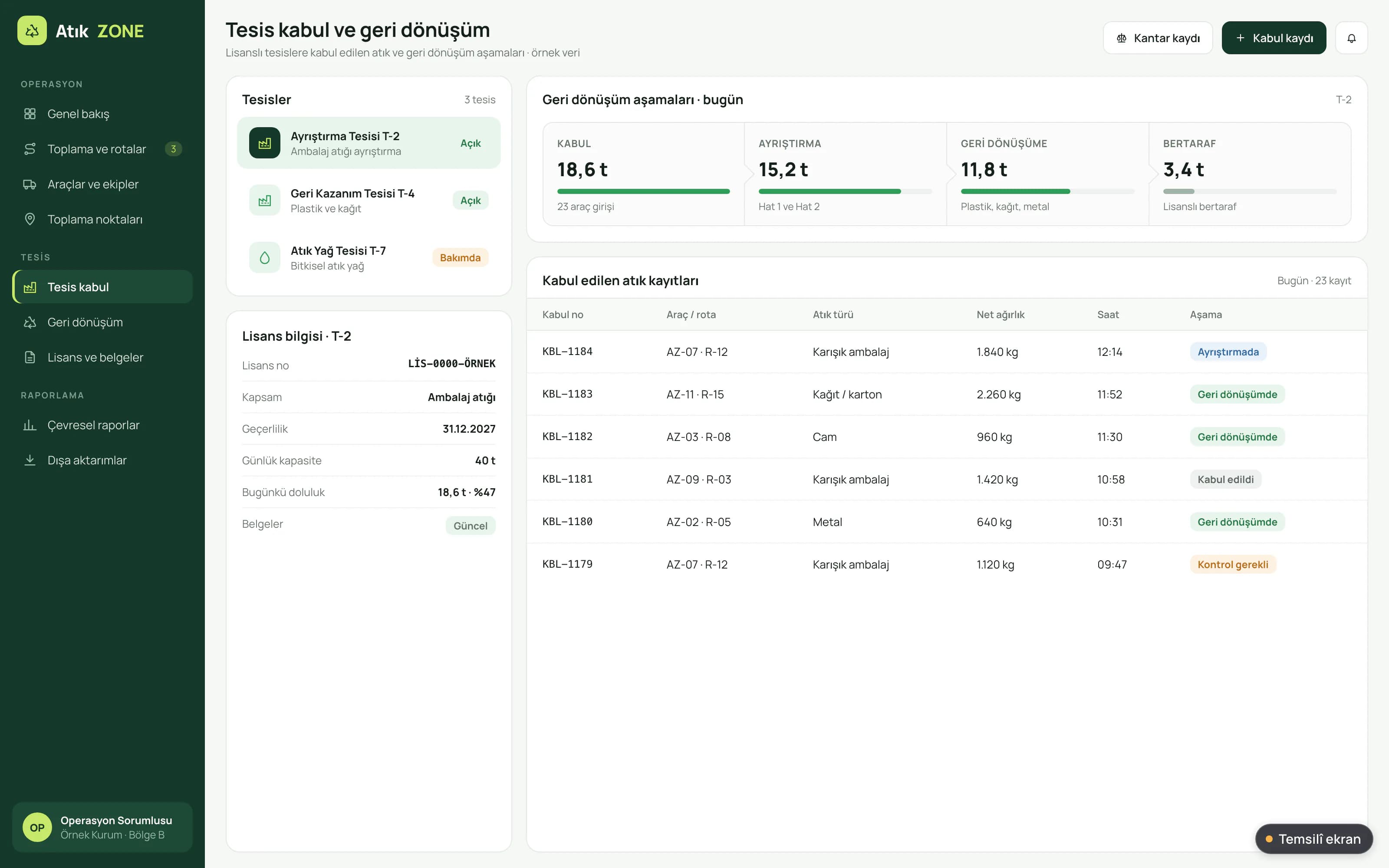
Illustrative screen Facility acceptance. Facility list, accepted waste records and recycling stage. Reporting
Environmental reports are prepared from operational records. The operation is assessed with these reports.
- Environmental reports are produced in the format the regulations require.
- Because every batch is recorded with its carbon equivalent, a carbon footprint report is prepared as well.
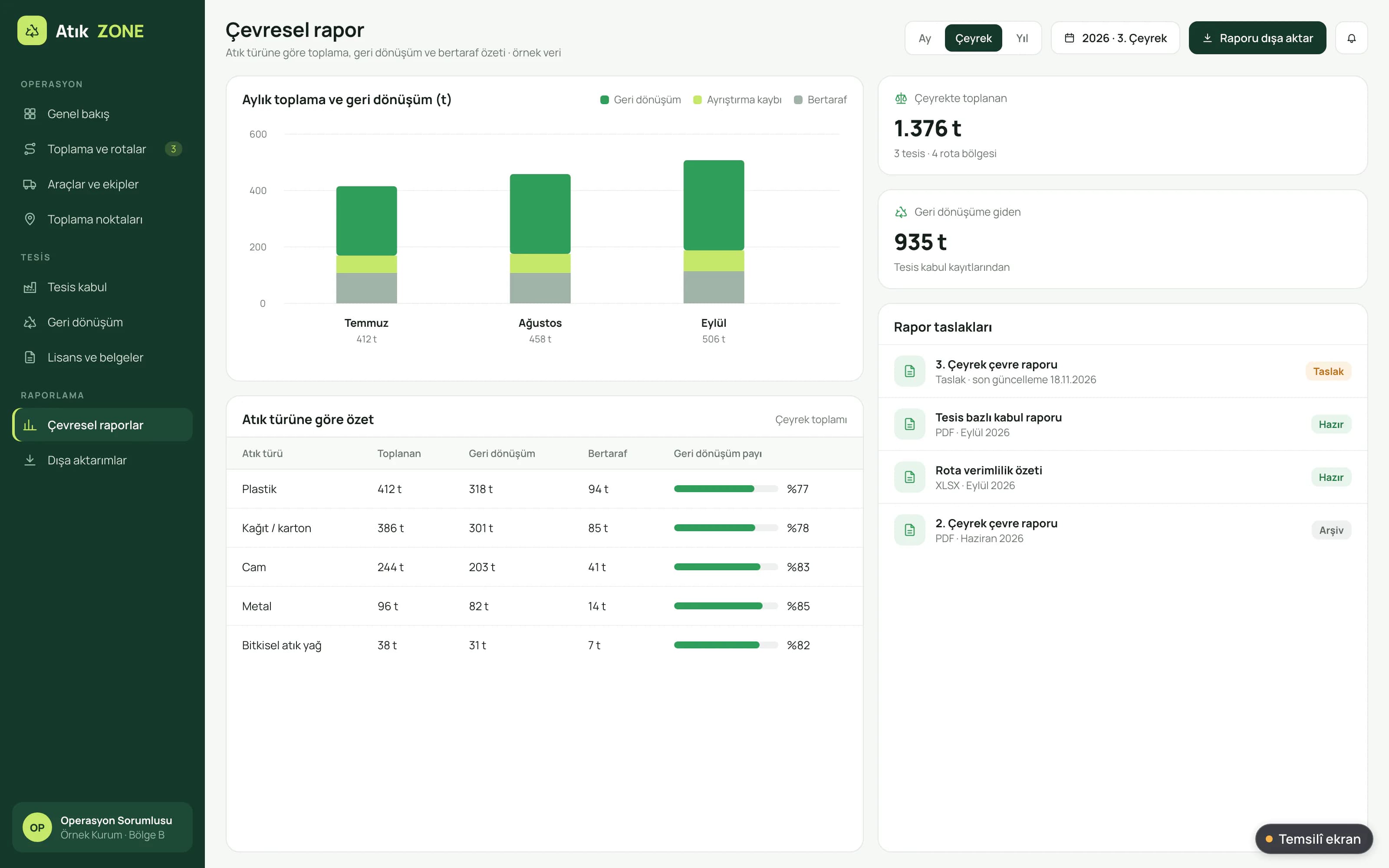
Illustrative screen Environmental report. Period selection and table by waste type; figures are sample data.
Waste declaration and tracking
The citizen or business producing the waste, the team collecting it and the licensed facility processing it all see the same record. The waste declaration is the first step of that record; waste type and weight travel with the batch from collection to the facility.
- Waste type and weight tracking
- A batch record that can be traced from collection to the facility
Vehicle and route management
Collection vehicles and their routes are managed from the organisation dashboard. Integration with vehicle tracking systems can be set up; container fill levels and shipments to licensed facilities are tracked on the same dashboard.
Citizen app and points system
Citizens drop off plastic, paper, metal and textile waste at the nearest point. The app shows the waste points earned and the carbon equivalent recycled; a campaign and reward mechanism supports participation.
- Plastic, paper, metal and textile drop-off
- Waste points and carbon equivalent are shown in the app.
- Campaign and reward mechanism
Maritime waste
The application we developed, and continue to maintain, for the Directorate General of Environmental Management of the Ministry of Environment, Urbanisation and Climate Change digitises the notification, collection and reporting of ship-generated waste. AtıkZONE is used in this project.
- Waste notification and collection flows
- Port and facility integrations
- Maintenance, repair and regulatory updates
Illustrative screens are prepared to explain what the product does; they contain no real institution, person or outcome data.
Systems AtıkZONE connects to
Which connections are set up is decided together in the project meeting.
Drop-off point
- KAZAN smart container
In KAZAN, the container opens with a QR code, the waste is weighed and points are credited to the citizen by waste type. When integrated with AtıkZONE, that drop-off enters the same flow as collection and the facility process.
Vehicle tracking
- Vehicle tracking systems
Facility software
- Licensed facility software
The path of a waste batch
- The waste is declared and the batch is recorded with its type and weight.
- Collection is planned around vehicles, routes and container fill levels and carried out in the field.
- The waste is shipped to a licensed facility and accepted there.
- The recycling process is tracked, and the batch's carbon equivalent stays on record.
- The environmental report and the carbon footprint report are prepared in the format the regulations require.
Frequently asked questions about AtıkZONE
How is it different from KAZAN?
KAZAN focuses on the drop-off point: the smart container opens with a QR code, the waste is weighed and points and balance are credited to the citizen by waste type. AtıkZONE tracks the waste's whole path: collection vehicles and routes, shipments to licensed facilities and environmental reports. When the two are integrated, the drop-off at the container enters the same flow as collection and the facility process.
Does it report in line with regulations?
Yes. Environmental reports are produced in the format the regulations require. In the maritime waste application, regulatory updates are part of the maintenance scope.
Does the team building the software know the field?
Yes. AtıkZONE and KAZAN are products of a team that has seen waste management in the field. ADL also provides field services in zero waste, recycling and wastewater treatment. The engineering and software teams are separate but work together on the same project, which keeps our environmental software suited to field conditions.
Who is it adapted for?
It is adapted for municipalities, organised industrial zones and large facilities. It is designed for any setting where the parties that produce, collect and process waste need to work on the same platform.
Where is it used?
It is used in the Maritime Waste Application of the Ministry of Environment, Urbanisation and Climate Change, whose development and maintenance are ongoing.
Projects delivered with this product
- Maritime Waste Application Ministry of Environment, Urbanisation and Climate Change · General Directorate of Environmental Management
Let's evaluate AtıkZONE together.
A 30-minute live demo of AtıkZONE and a pilot plan tailored to your organisation. Share how your collection, facilities and reporting are set up, and we will define the scope together.
Let's talk