
CRM A request arrives. Tracking begins.
ADL CRM is request management software that records requests and applications arriving from different channels, routes them to the responsible unit and tracks them until they are resolved.
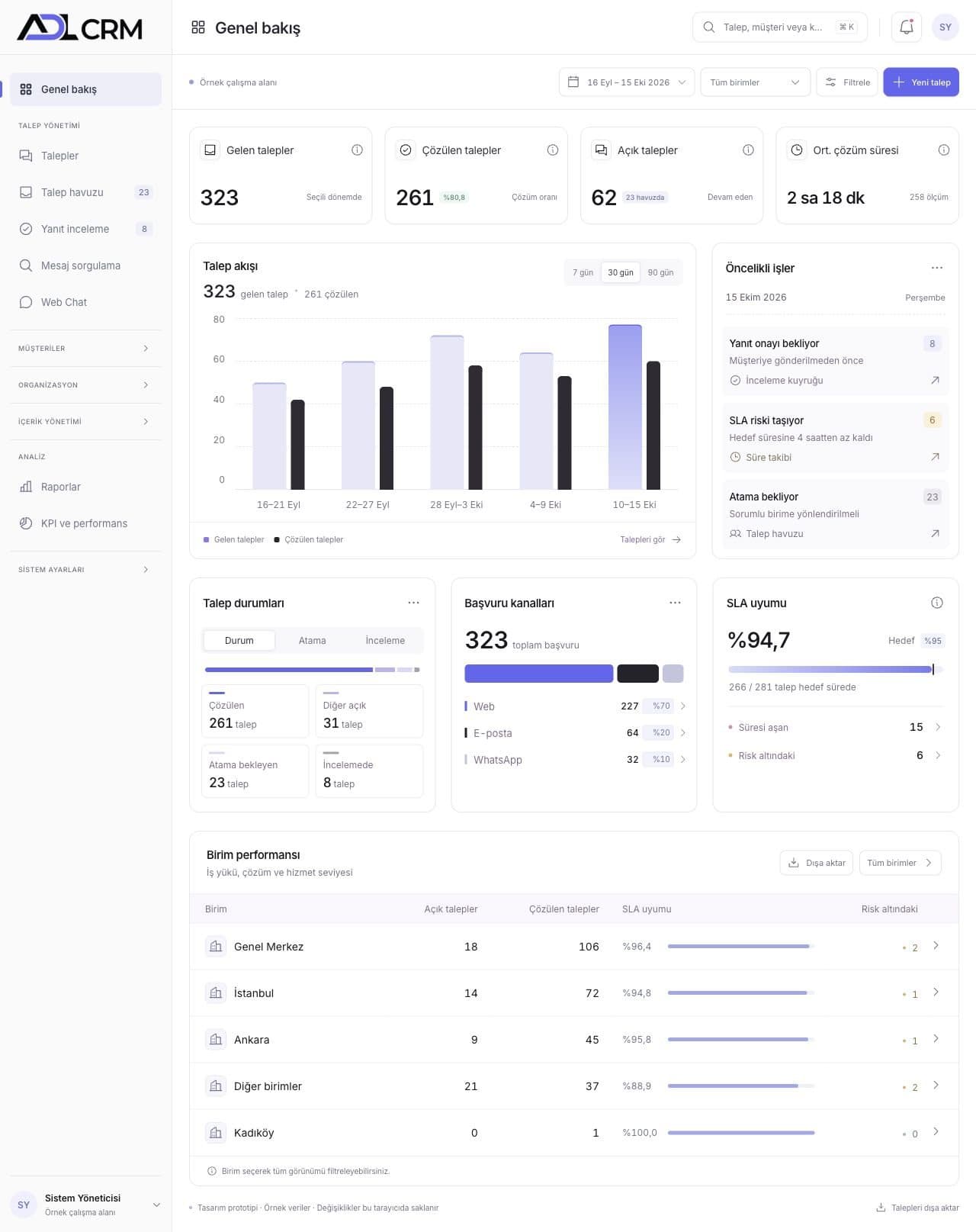
Product images are taken from the presentations in our promotional catalogue.
Who uses it
Used by the customer service, call centre and back-office teams of institutions that receive requests and applications.
What problem it solves
Requests arrive from different channels such as web, e-mail or messaging. When channels are tracked separately, it is noticed late who a request is waiting on and whether it has exceeded its target time. ADL CRM gathers requests in a single pool and keeps each one traceable until it is resolved.
The teams that touch an application
An application rarely starts and ends with one person: the agent who opens the record, the unit that takes on the work and the manager who follows the outcome all work on the same record.
Call centre agent
Records an application arriving by phone, message or mobile app, classifies it and routes it to the responsible unit. If the citizen calls back later, the same file is found.
Responsible unit
Processes the requests assigned to it, prepares the reply and sends it for review. Messages about the application stay next to the application.
Back-office team
In high-volume customer service, finds the record quickly, works from the queue by urgency and closes complaint and refund flows.
Unit and operations manager
Follows requests approaching their target time, unit performance, map-based application density and the AI-assisted management report.
What ADL CRM manages
Request pool and routing
Requests and applications from different channels are gathered in a single pool. A request awaiting assignment is routed to the responsible unit.
- Every application is captured and recorded, whichever channel it comes from.
- Incoming requests are classified, prioritised and assigned to the right person.
- Duplicate applications opened on the same subject are detected automatically.
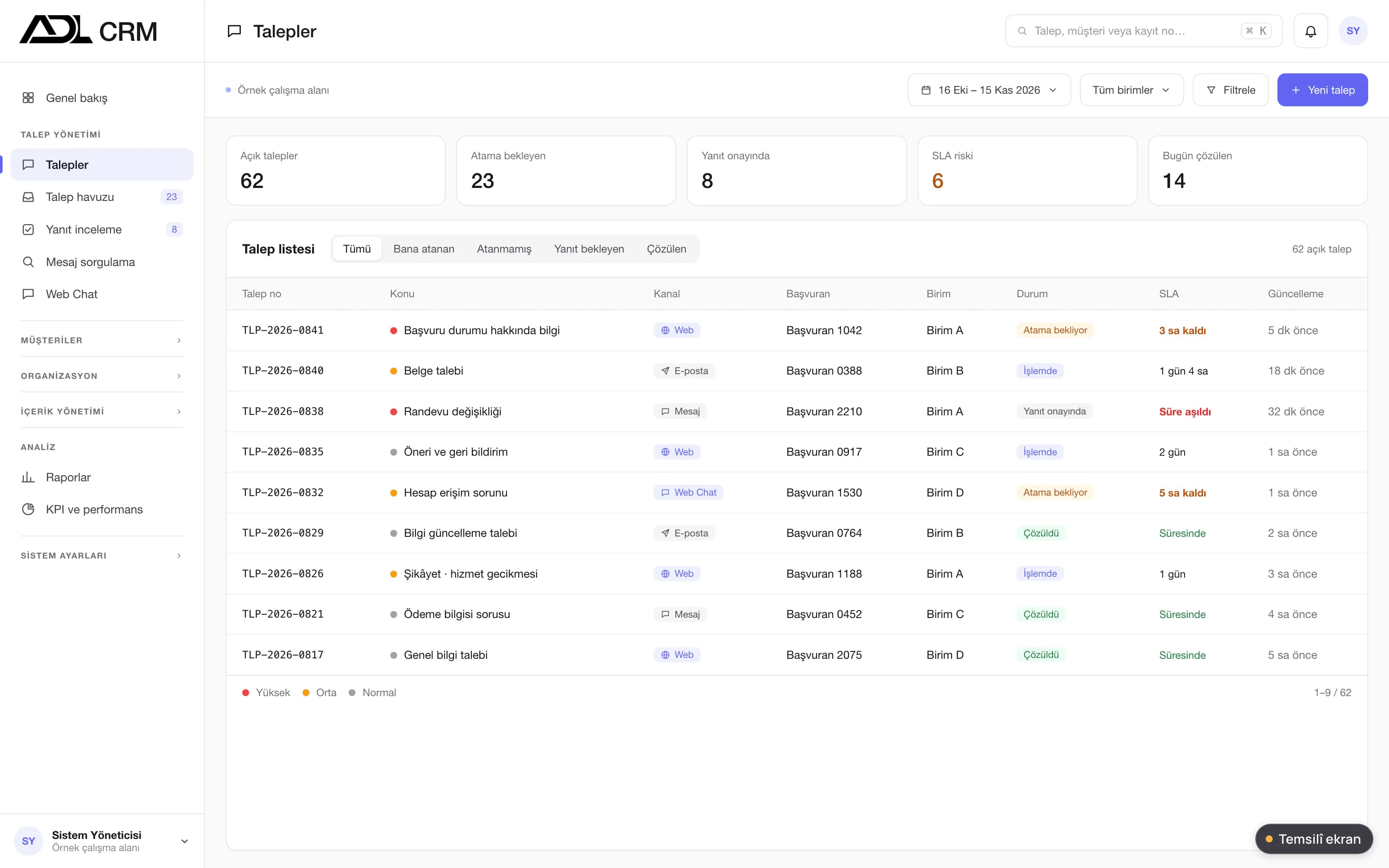
Illustrative screen Request list. Channel, subject, responsible unit and status columns; records are samples. Reply review
A prepared reply enters a review queue before it is sent to the requester. The approved reply is delivered to the requester.
- No reply reaches the requester before it is approved.
- The team's internal messages about an application are not lost in e-mail chains; they stay next to the application.
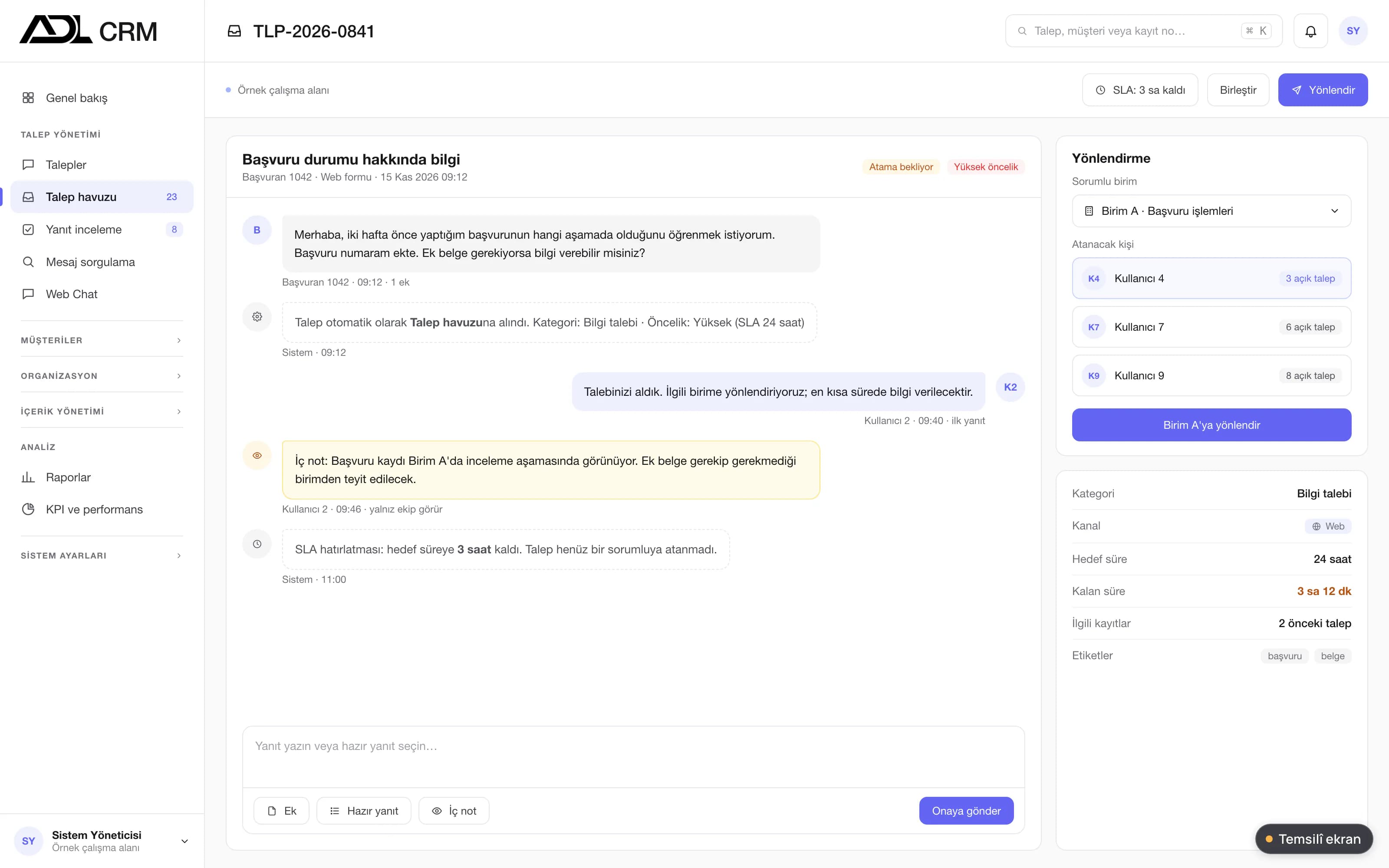
Illustrative screen Request detail. Request history, routing to a unit and pre-send reply review. Status and SLA tracking
The status of every request is tracked: awaiting assignment, under review, open or resolved. Requests approaching their target time are surfaced among priority work.
- Resolution times for complaints are tracked separately.
- For every application you can see who resolved it and how long it took.
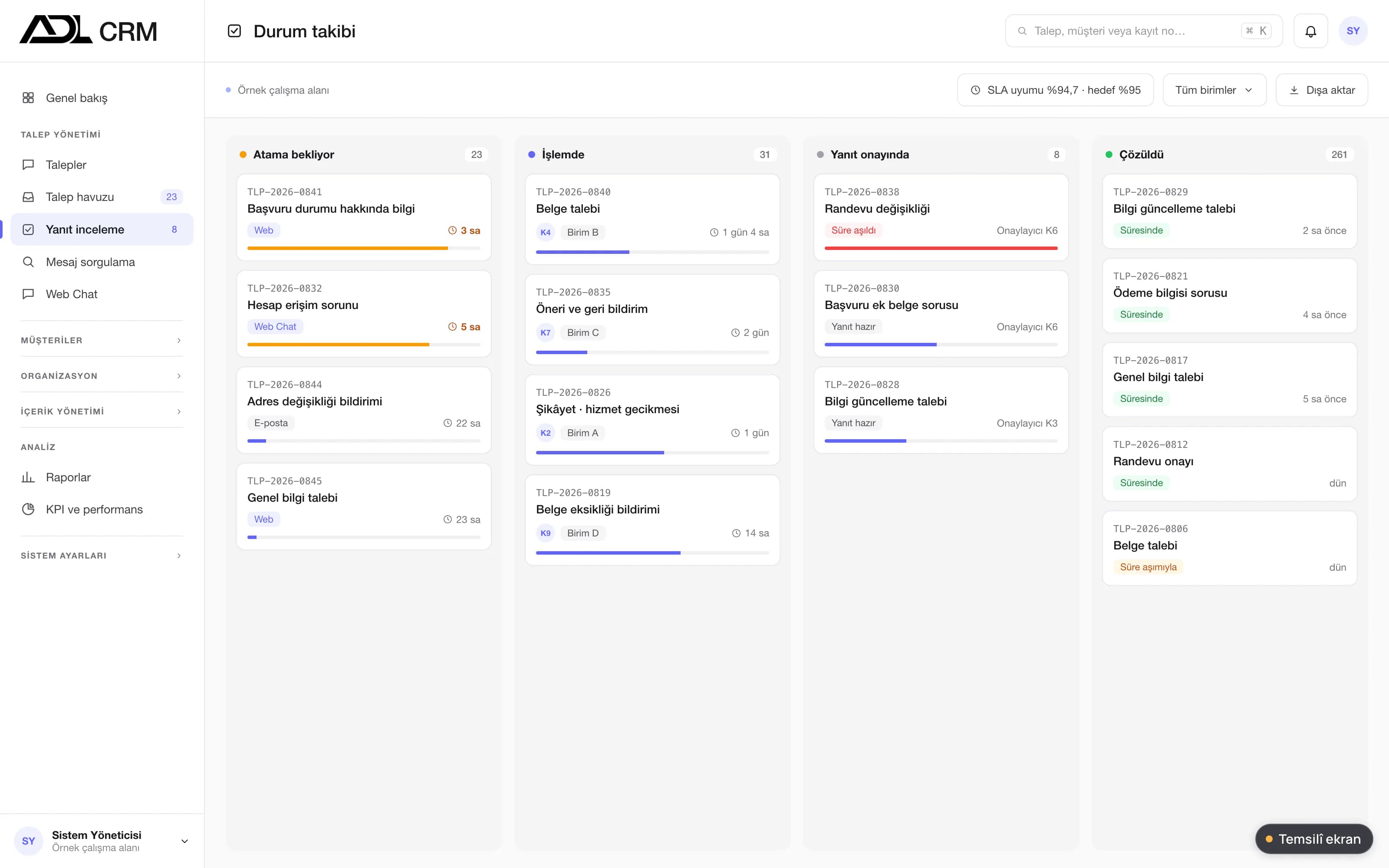
Illustrative screen Status and SLA tracking. Requests by status and those approaching target time; figures are samples.
Reports and unit performance
Incoming and resolved requests are reported by period and by unit. Units' workload, resolution status and service level are seen in the same table.
- Recurring problems are reported, so root causes become visible.
- The team's real efficiency and performance are managed on the same screen as customer requests.
Roles and integration
Users work with role-based permissions; the role determines who performs which action. The scope of connection with the institution's existing systems is defined per project.
Requests, complaints and suggestions
The platform brings request, complaint and suggestion management together in one structure; in the ALO 181 installation, information requests run in the same flow. Each application type has its own tracking, and all of them sit in the same record structure.
- Requests: classification, prioritisation, assignment to the right person and live status tracking.
- Complaints: resolution time tracking and a report of recurring problems.
- Suggestions: customer feedback is recorded and becomes a concrete data source for product and service development.
Manager dashboard
The manager dashboard keeps a finger on the pulse of the whole operation from one screen. The AI-assisted management report gives concrete guidance on which applications or which teams should be prioritised.
- Map-based analysis: you see geographically which applications are rising in which region.
- Request density and average resolution times can be read at a glance.
- Duplicate application detection prevents wasted time.
ADL CRM in the call centre
We do not only develop ADL CRM; we also use it in the call centres we operate ourselves. At ALO 181, the team that handles citizens' information requests, reports and complaints records each application in ADL CRM and routes it to the institution's units. We operated ALO 184 SABIM, the Ministry of Health Communication Centre, with 845 call centre staff, including software, hardware and premises.
- We build, train and manage the team, and we also develop the software the team uses.
- Phone, SMS, web chat, mobile app and e-mail come together in the same CRM record.
- An application opened in ALO181 Mobile appears in the ADL CRM used by the call centre under the same record number.
HGS Backoffice CRM
The request management logic that matured in our call centre operations was adapted to high-volume private-sector customer service. HGS Backoffice CRM tracks customer requests and objections about the HGS toll system from one centre; it finds a request by licence plate, date and toll record and queues it by urgency.
- Service request search and creation, an urgency-based queue and elapsed time tracking.
- Complaint and refund flows, plus definitions management.
- Customer feedback after resolution is added to the same record.
- Daily request volume, category distribution, average resolution time and team performance are compared period by period.
Illustrative screens are prepared to explain what the product does; they contain no real institution, person or outcome data.
Where applications come from
ADL CRM gathers every contact with the customer into a single flow. If the institution has existing infrastructure, it connects to that too; which connections are set up is decided in the project meeting.
Public channels
- CIMER
- BTK
Channels through which applications reach public institutions.
Communication channels
- Phone / call centre
- SMS
- Social media
The channels through which customers or citizens write to and talk with the institution.
Citizen mobile app
- ALO181 Mobile
An application supported by location and images is managed on the same record as the call centre.
Developer connections
- Open API
- Webhook
Data exchange with the institution's own systems.
The path of an application
- A request arrives via web, e-mail or messaging and is recorded.
- It is assigned from the request pool to the responsible unit.
- The unit processes the request and prepares the reply.
- The reply is reviewed and approved before it is sent.
- The request is tracked against its target time until it is resolved.
- Unit performance is reported.
Frequently asked questions about ADL CRM
Does it work with my existing systems and with public channels?
Yes. Public channels such as CIMER and BTK; communication channels such as phone, WhatsApp, SMS, e-mail and social media; and open API and webhook connections are among the integrations. If the institution has existing infrastructure, we integrate with that as well.
Will it fit the way my institution works?
ADL CRM does not impose a single template; it is not an off-the-shelf package. It is customised to the institution's needs, equipped with institution-specific tools and shaped together as processes grow. Role-based permissions and routing to units are part of this tailoring too.
Where is it used?
The ALO 181 call centre CRM software of the Ministry of Environment, Urbanisation and Climate Change is ADL CRM's first large public-sector installation, and we still operate the ALO 181 call centre with this software today. The system that manages PTT's customer applications from one centre and the Ministry of Health's ALO 184 SABIM call centre also ran on ADL CRM.
Is it only software, or do you provide the call centre team as well?
It can be both. ADL CRM and ALO181 Mobile are our own products, and we also operate call centres on behalf of institutions. Recruiting and training the team, quality measurement and reporting are our responsibility. The premises can be ours or at the institution's own location.
Can I measure the outcomes of applications?
Yes. For every application you can see who resolved it and how long it took. Incoming and resolved requests are reported by period and by unit; requests approaching their target time are surfaced, and map-based analysis shows request density and average resolution time by region.
Status
Part of ADL's product portfolio. Product and service scope is defined in the relevant project meeting.
The CRM software we developed for call centre and back-office teams (ALO 181 and a back-office CRM system) and the application and real estate management work we carry out for PTT are on the Projects page. Projects page
Projects delivered with this product
- ALO 181 call centre operation and mobile application Ministry of Environment, Urbanisation and Climate Change
- ALO 181 call centre CRM software Ministry of Environment, Urbanisation and Climate Change
- ALO 184 SABIM call centre service contract Ministry of Health · General Directorate of Health Promotion
- Call centre CRM software project
- Back-office CRM system
- Customer Applications Management System PTT A.Ş.
Let's evaluate CRM together.
A 30-minute live demo of ADL CRM and a pilot plan tailored to your team. Share the channels your applications come from, and we will define the scope together.
Let's talk